


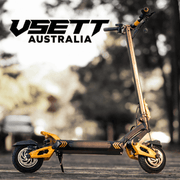
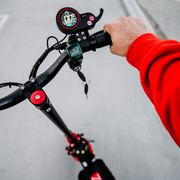

If you've read anything about e-bikes in the news lately, you've probably seen “illegal,” “compliant,” “certified,” and “road legal” thrown around like they mean the same thing. They don't, and that gap is exactly where the recent confusion over police seizures has been coming from. We'd rather you understand the real picture than just take our word that a bike is “fine.”
The simplest way to think about it
There are really three categories of vehicle, and where your bike sits between them is what the law cares about:
● A motorbike runs entirely on its motor.
● A push bike runs entirely on your legs.
● An e-bike sits in the middle. You pedal, and the motor gives you a boost from its battery.
What matters under the law is that second part: you're pedalling, and the motor is helping, not doing the work for you. If a bike can move on the motor alone, or pushes past the power and speed limits that define an e-bike, the law stops treating it as a bicycle and starts treating it as an unregistered motor vehicle. That's the point at which fines and seizures come in.
“Compliant” and “road legal” aren't quite the same thing.
Compliant means a bike has been tested against a specific technical standard. A lab has checked its power output, its speed cutoff, how the assist behaves, and issued a certificate to prove it.
Road legal means you're actually allowed to ride that bike on public roads and paths under your state's road rules.
A properly compliant bike is generally road legal too. That's the whole point of the standard existing. But they're not the same word, and knowing the difference is worth more than you'd think if you're ever asked to explain your bike to someone on the side of the road.
What's an EPAC?
EPAC stands for Electrically Power-Assisted Cycle. The technical name for what most of us just call an e-bike. To count as an EPAC rather than an unregistered motor vehicle, a bike generally needs to:
● Use the motor to assist pedalling, not replace it.
● Cap continuous motor power (250W in most of Australia; NSW allows up to 500W)
● Cut the motor assist at 25 km/h
● Still works as a normal pedal bike if the power's off
E-bike motor wattage explained: why the number on the label isn't the legal number
Here's something we can back with real confidence, because it's shown up independently in more than one place we trust: the wattage printed on a motor housing or buried in its serial number is not the same as the bike's tested continuous power rating. A motor might carry a code referencing its peak or series output, while the number that actually determines legality is the continuous rating measured under sustained load, on the complete system (motor, controller and battery together), not a number stamped on a part or splashed across an ad. You genuinely can't judge a bike's legal status from a label alone; you need the test report.
EN15194 — the standard that proves it
EN15194 is the standard that formally defines an EPAC and tests a bike against that definition: motor output, speed cutoff, electrical safety, and all of it. A bike carrying EN15194 certification has been independently verified by an accredited lab, not just described that way by whoever's selling it.
UL certification vs EN15194: what's the difference for e-bikes?
UL certification (such as UL 2849) primarily tests battery and electrical safety, the things that matter for fire risk, overheating, and safe charging. That's a genuinely serious concern in its own right, but it's a different question to "Does this bike meet the legal definition of a road-legal EPAC?” UL tells you the battery won't catch fire; EN15194 tells you the bike itself is legally a bicycle. Neither one is a substitute for the other.
Where things get genuinely complicated: the rules are still moving
Part of the current confusion isn't about any one brand. Australian e-bike regulation is actively being rewritten, state by state, while riders are already out on the road. A few things worth knowing:
● The national baseline is 250W, EN15194, 25 km/h cutoff — legal everywhere.
● NSW is the exception, allowing up to 500W and a throttle to 6 km/h.
● Queensland has introduced a hard deadline: from 1 July 2026, e-bikes ridden in public need to meet EN15194, or be verified against core safety requirements by 28 February 2027 under a scheme the QLD Government hasn't finished publishing yet. QLD is also introducing a minimum age of 16 and a Learner licence requirement from 31 August 2026.
● Western Australia also requires riders to be 16+.
If you own an older model, or you're not sure where your specific bike sits, don't guess, check the certification documentation for your exact model, and if you can't find it, ask us directly.
The 60-second check
If you want a quick gut-check on your own bike, ask:
● Does the motor only assist while you're pedalling? No sit-back-and-throttle riding?
● Does the assist cut out at 25 km/h?
● Is it still in factory spec? no modifications to the motor, controller, battery, or settings?
● Can you find an actual certificate (not just a sticker or a claim) backing it up?
If you're unsure about any of these, that's worth chasing down before you ride, not after.
Tell us about your experience
If you've ever been stopped, questioned, or had your e-bike seized or fined by police, we'd genuinely like to hear about it. What happened, how it was handled, and what you wish you'd known beforehand. There's no wrong answer, and you can share as little or as much detail as you're comfortable with.
This isn't about pointing fingers at anyone. It's about building a real, honest picture of how these rules are actually playing out for riders, so we can keep pushing for clarity, and so other riders know what to expect.
The bottom line
We'd rather tell you exactly what's certified, what isn't yet, and what's still genuinely unsettled in the law than tell you everything's fine and leave you to find out otherwise on the side of the road. If you want to check where your specific model stands, get in touch, we'll give you a straight answer.